
Why Click Timing Consistency Matters in Geometry Dash
CPS is an average
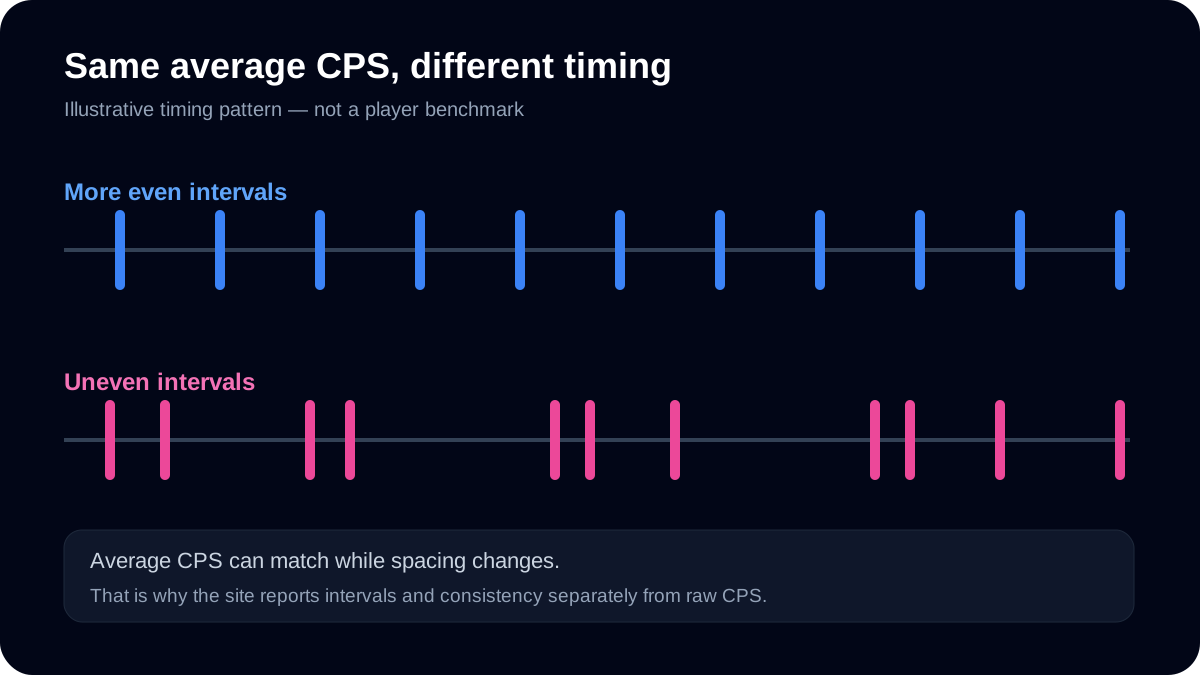
A 10 CPS result means ten registered inputs per second on average. It does not tell you whether those clicks arrived evenly. A run with alternating very short and very long intervals can produce the same CPS as a run with stable spacing.
Look at intervals
The updated CPS Test records average interval, a short-burst peak estimate and a consistency score. Those numbers are browser-side training diagnostics rather than laboratory measurements.
What this site actually calculates
A completed CPS run divides registered input count by the selected test duration in seconds. The first valid click starts the clock and counts toward the total. The Peak 1s indicator counts the largest number of clicks found within a rolling one-second span of recorded timestamps. It is a count in that window, not an instantaneous hardware polling measurement.
To calculate the average interval, the test subtracts each click's timestamp from the next, then averages those gaps in milliseconds. The consistency percentage is a site-defined transformation of interval variation: approximately 100 × (1 − standard deviation ÷ mean interval), clipped to 0–100. It is not a percentile, an accuracy rate, or an official Geometry Dash score. With too few intervals, the tool reports N/A rather than inventing a percentage.
Worked example: why the averages mislead
Imagine clicks separated by 100, 100 and 100 ms in one short sequence, versus 50, 150 and 100 ms in another. Both have a mean interval of 100 ms, but the first has no interval variation in this tiny example. The second has noticeable variation. Those are illustrative event times, not observed player data; they show why two similar average speeds can feel different during wave corrections.
Browser input delivery, tab scheduling and device behavior affect timestamps. Even a high consistency score does not prove that the game engine receives identical timing, nor does it guarantee that a particular level will be easier.
Original exercise / comparison: definitions matched to the CPS result component's calculation, not independently measured hardware results.
Why this matters for wave control
Repeated wave corrections depend on when inputs arrive. If your interval pattern changes dramatically from click to click, the same average CPS can still produce a less predictable trajectory.
Use the Spam Test after a CPS run to see whether the timing pattern transfers into a controllable path.
This article explains the measurement. For a practical training routine, use How to Improve CPS in Geometry Dash.
Ready to Test Your Skills?
Don't just read about it. Put your clicking speed and wave consistency to the test right now.
Written By
Geometry Dash Spam Editorial
Maintains the site's browser tools and source-checked training guides.